Replacing the windows in your home is one of the larger investments you will make as a homeowner, and it is not something you want to redo in five years because the wrong company installed the wrong product the wrong way. Before you sign anything, you should be asking pointed questions and expecting straight answers. This guide walks through what to ask, why each question matters, and what a homeowner in the Philadelphia metro area or the Poconos should listen for in the response.
Why the Right Questions Matter Before You Sign a Contract
Window replacement is a trade where the visible result (a clean, finished-looking window) can hide a poor installation underneath. Flashing done incorrectly, insulation gaps around the frame, or a mismatched product for your home’s construction type will not show up as a problem on day one. They show up as drafts, condensation, or water intrusion a season or two later, once the contractor is long gone and hard to reach. Asking the right questions up front is how you screen for a company that will still stand behind the work after the invoice is paid, not just one that can hang a window.
A homeowner does not need to become a construction expert to protect themselves. You just need a short list of questions that separate a contractor who does this professionally, year round, from someone who picked up a side job installing windows. The sections below cover licensing, product knowledge, installation practices, warranty coverage, and pricing transparency, in that order, because that is roughly the order in which problems tend to surface if any of them were skipped.
Ask About Licensing, Insurance, and Local Registration
In Pennsylvania, any contractor performing home improvement work over a certain dollar threshold is required to be registered with the state as a Home Improvement Contractor (HIC). This is not optional, and it is easy to verify. Ask for the contractor’s PA HIC license number and check it against the Pennsylvania Attorney General’s HIC registry yourself rather than taking someone’s word for it. A registered, active license tells you the state has that business on record and that there is a formal path for recourse if something goes wrong.
Beyond state registration, ask specifically about liability insurance and workers’ compensation coverage. If a worker is injured on your property and the contractor carries no coverage, that liability can fall back on you as the homeowner. A legitimate contractor will produce proof of insurance without hesitation. If you get vague answers or the person seems annoyed by the question, treat that as useful information in itself.
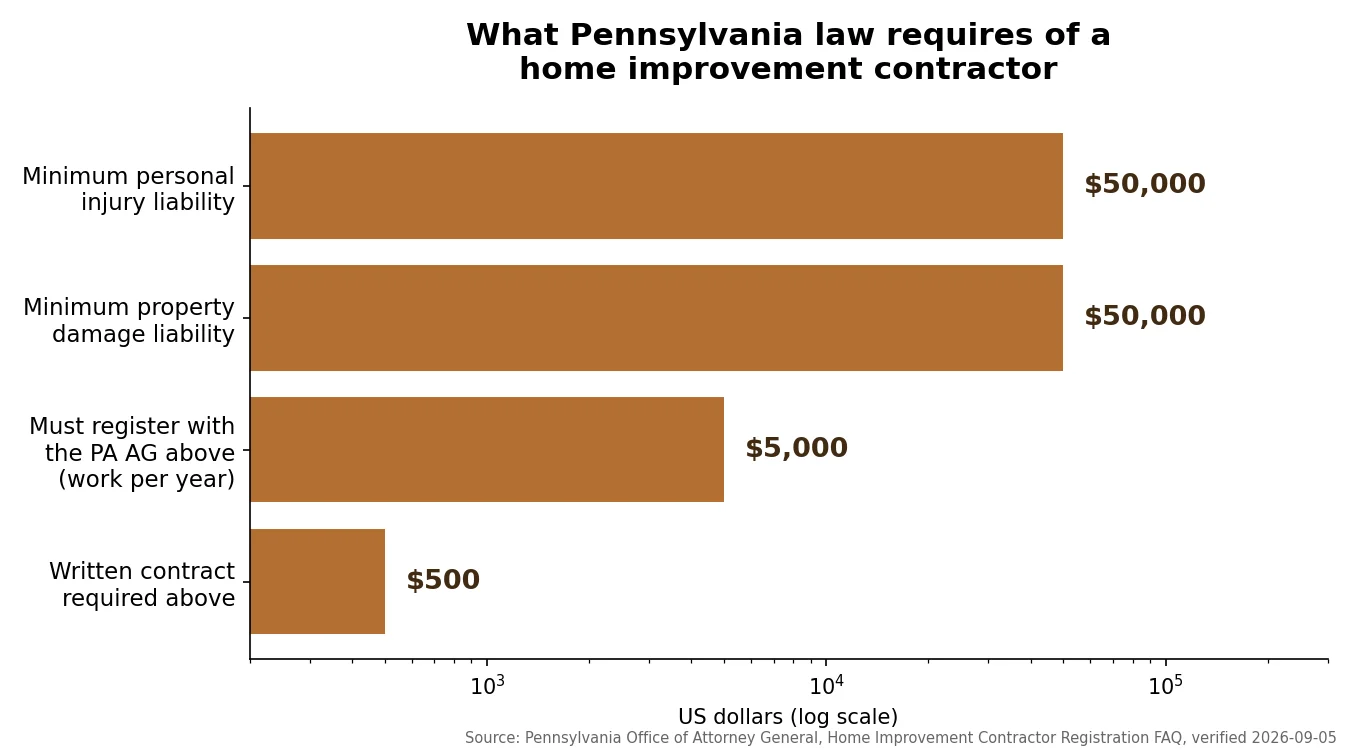
Pennsylvania sets these as floors, not targets. Source: Pennsylvania Office of Attorney General, Home Improvement Contractor Registration FAQ, verified September 2026.
- What is your PA HIC license number, and can I verify it myself?
- Do you carry general liability insurance and workers’ compensation?
- Are you a local business with a physical address I can visit?
- How long have you been installing windows in this specific area?
Questions About Window Materials and Product Lines
Not every window is built the same way, and the right choice depends on your home’s age, exterior material, and budget. A contractor who only sells one product line, and pushes it regardless of your home’s needs, is not necessarily giving you the best fit. Ask what materials and series they carry, why they recommend one over another for your specific house, and what the tradeoffs are between options like fiberglass, vinyl, and wood-composite frames.
It is worth reading up on the differences yourself before the conversation. A page like this overview of window materials breaks down how frame material affects durability, insulation, and maintenance over time, which gives you a baseline for judging whether a contractor’s recommendation actually makes sense for your project or is just whatever they have the most of in stock.
If a contractor represents a specific manufacturer, ask which series within that manufacturer’s lineup they are proposing and why. For example, entry-level and premium lines from the same brand can differ by hundreds of dollars per window in glass options, hardware, and frame construction. Comparing something like the the Andersen 100 Series against the Andersen 400 Series or the the Andersen A-Series shows how much variation exists even within one manufacturer, and a good contractor should be able to explain those differences in plain terms rather than steering you toward whichever product has the highest margin.
- What window materials and manufacturer lines do you install?
- Why do you recommend this specific product for my home?
- What are the energy performance ratings for this window, and where do those numbers come from?
- Can I see a physical sample of the frame and glass before I decide?
Questions About the Installation Process Itself
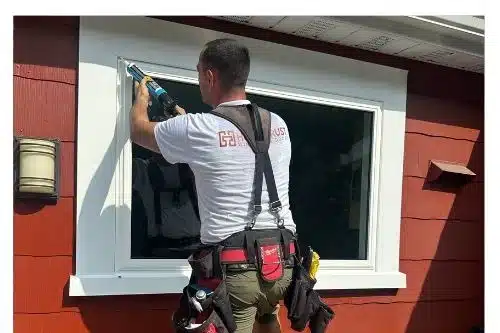
The product is only half of the job. Installation quality is what determines whether a window performs the way it is rated to perform. Ask the contractor to walk you through their installation process step by step: how they handle removal of the old window, how they address flashing and moisture barriers, how they insulate around the new frame, and how they finish the interior and exterior trim.
You should also ask whether the people doing the physical installation are employees of the company or subcontracted out to a different crew for each job. There is nothing automatically wrong with subcontracting, but you want to know who is actually going to be in your home, whether they have been trained specifically on the product being installed, and who fixes it if the installation itself causes a problem later, separate from any manufacturer defect in the window.
- Who will physically perform the installation, and are they employees or subcontractors?
- What is your process for flashing, sealing, and insulating around the new frame?
- How do you protect my home’s interior and landscaping during the work?
- How long does a typical installation take, from start to cleanup?
Questions About Warranties, Manufacturer Coverage, and Follow Up
There are usually two separate warranties involved in a window replacement: the manufacturer’s warranty on the product itself, and the contractor’s warranty on their labor and installation. These are not the same thing, and a homeowner should understand both before signing. A window can be defect free and still leak or draft if the installation was flawed, and in that case the manufacturer’s warranty will not help you, only the contractor’s labor warranty will.
Ask for the warranty terms in writing, not just verbally. Find out what is covered, what voids the coverage, how long it lasts, and what the process looks like if you need to file a claim two or three years down the road. A contractor confident in their own workmanship will not hesitate to put a labor warranty in writing and explain exactly how a homeowner would use it if a problem ever came up.
- What does the manufacturer’s product warranty cover, and for how long?
- What does your labor and installation warranty cover, separate from the product warranty?
- What voids either warranty?
- What is the actual process if I need to file a claim after installation?
Questions About Timeline, Permits, and Project Communication
Window replacement projects can involve permitting depending on your municipality and the scope of the work, particularly if the project changes the structural opening or affects egress requirements. Ask directly whether your project requires a permit, and if so, who fixes it pulling it. A contractor who handles permitting as a routine part of their process is signaling that they operate above board with local building departments, which matters for both safety and for resale purposes later, since unpermitted work can complicate a home sale.
Also ask about the realistic timeline from signing the contract to completed installation, including how long custom orders typically take to arrive from the manufacturer versus in-stock products. Ask who your point of contact will be throughout the project and how you will be updated if there are delays.
- Does this project require a permit, and who fixes it obtaining it?
- What is the realistic timeline from order to installation?
- Who is my point of contact if I have questions during the project?
- How will I be notified if there is a delay or change in schedule?
Questions About Pricing, Financing, and Tax Incentives
Get a detailed, itemized written estimate rather than a single lump sum figure. You want to see the cost broken down by product, labor, and any additional work such as trim or disposal of old materials, so you can compare quotes between contractors on an apples-to-apples basis. Be cautious of any estimate that is dramatically lower than others you have collected, since that gap often shows up later as a lower-grade product, a rushed installation, or hidden change orders.
Be careful here, because a lot of window sales copy is still out of date. There is no federal tax credit for windows installed in 2026. The 25C Energy Efficient Home Improvement Credit was repealed by the One Big Beautiful Bill Act, and the IRS states it will not be allowed for any property placed in service after December 31, 2025. If a salesperson tells you the windows they are quoting qualify for a federal credit this year, that is a direct test of whether they are current on their own industry. Our 25C tax credit status page lays out what changed and what a 2025 install can still claim.
- Can I get an itemized, written estimate broken down by product and labor?
- Are you quoting any federal tax credit on this job, and can you cite the authority for it?
- What financing options do you offer, and what are the actual terms?
- What is included in the price, and what would count as an extra charge?
What Local, Hands-On Experience Brings to This Conversation
Ask us the same questions. HomeTrust Windows and Doors holds Pennsylvania Home Improvement Contractor registration PA171374, active through May 26, 2028, and New Jersey Home Improvement Contractor registration 13VH12274600, and we hold a 4.9 star rating across 54 Google reviews as of September 2026. Those are the three answers the licensing section above tells you to demand, published here so you can check them before you call.
These questions matter most when they are answered by people who actually do this work every day in your region’s housing stock, not a call center reading from a script. HomeTrust Windows & Doors is based in Huntingdon Valley, Pennsylvania, and works on homes throughout the Philadelphia metro area, with installations that account for the age and construction styles common to this region, from older rowhomes to newer suburban construction. That repeated local exposure to real installation conditions, different frame types, and different manufacturer lines is what allows a contractor to answer these questions specifically rather than generically. Homeowners considering options across product families like the the Andersen 200 Series, the the Andersen 400 Series Woodwright, or the Andersen E-Series can ask a company that installs in these towns every week to explain the real differences rather than reciting a brochure.
Frequently Asked Questions
How do I verify a window contractor’s license in Pennsylvania?
You can check any contractor’s Home Improvement Contractor registration status directly through the Pennsylvania Attorney General’s public HIC registry, which lists whether a license is active and in good standing.
Is the manufacturer’s warranty the same as the contractor’s warranty?
No. The manufacturer’s warranty covers defects in the window product itself, while the contractor’s labor warranty covers the quality of the installation. Ask about both separately and get the terms in writing.
Do I need a permit to replace windows in my home?
It depends on your municipality and the scope of the work, especially if the project changes the structural opening. Ask your contractor directly whether a permit is required for your specific project and who will handle obtaining it.
How can I tell if a quote is too good to be true?
Compare itemized, written estimates from more than one contractor. A quote well below the others often reflects a lower-grade product, a rushed installation schedule, or costs that will appear later as change orders.
Is there a federal tax credit for replacement windows in 2026?
No. The 25C Energy Efficient Home Improvement Credit was repealed under the One Big Beautiful Bill Act, and the IRS states it is not allowed for any property placed in service after December 31, 2025. Windows installed during 2025 may still be claimed on that year’s return. If a contractor quotes you a 2026 federal window credit, ask them to cite it.
If you are planning a window replacement project in the Philadelphia metro area or the Poconos and want straight answers to these questions from a local, licensed team, reach out to HomeTrust Windows and Doors. You can see the lines we carry on our premium windows page, our process in Huntingdon Valley, and terms on our financing page. We are happy to walk through your home’s specific needs, show you real product samples, and give you a written estimate with no pressure attached.
Call HomeTrust Windows and Doors at (215) 341-3331 and put these questions to us directly.